





Table of Content
The most common lift emergency phone problems are reliance on ageing networks, limited wiring, failed test calls, incorrect lift identification, poor audio, incompatible configurations and rising maintenance costs. Checking the complete alarm system before specifying an upgrade helps identify the right solution and avoid repeat visits.
Upgrading a lift emergency phone can appear straightforward. For a lift maintenance company, however, choosing and installing the right system involves more than replacing a device.
The available wiring, mobile signal, age of the installation and compatibility with the answering service can all affect the work required. An incomplete survey can turn a planned upgrade into several engineer visits.
In the UK, the PSTN switch-off and retirement of older mobile networks make this assessment particularly important. The replacement system needs to support reliable communication, correct lift identification and continued operation during a power failure.
Below, we explore seven common problems faced by independent lift maintenance companies (ILMs) and the checks that help resolve them.
At a glance
Before upgrading a lift emergency phone, check its connection type, available wiring, mobile signal, lift identification, audio quality, backup power and compatibility with the answering service.
Ageing technology
1. The lift emergency phone relies on ageing technology
Many lifts still use traditional telephone lines or gateways that depend on older mobile networks.
Openreach has set 31 January 2027 as the national PSTN transition deadline. Individual connections may change sooner, so confirm the timetable with the building owner and their telecoms provider.
Mobile connections also need checking. A gateway labelled “4G” may still depend on an older network for voice calls. Verify that the gateway, SIM and service support voice over 4G, known as VoLTE.
Waiting until the connection fails can lead to:
- Urgent call-outs
- Lift downtime while faults are assessed and rectified
- Repeat visits to the same site
- Delays obtaining suitable equipment
- Disruption for building owners and passengers
- Upgrades with little time for planning and commissioning
What should you check?
Before proposing a replacement, identify:
- The existing emergency phone and gateway
- Whether calls use a traditional landline, mobile gateway or IP connection
- The voice technology supported by the equipment, SIM and service
- How the lift identifier reaches the answering service
- Whether the existing phone can be retained
- The installation’s backup power requirements
- The provider’s migration or withdrawal timetable
A suitable analogue phone may be retained with a compatible 4G VoLTE gateway. Other installations may benefit from a complete digital communication system.
For UK upgrade planning, see our Digital Switch guidance and 2G Shutdown resources.
Only two wires
2. The lift has only two wires available
Limited spare conductors can restrict the choice of emergency communication equipment in older lifts.
If the proposed system needs more wiring than is available, replacing or modifying the travelling cable can increase installation time, labour costs and disruption.
It may also involve:
- Longer periods with the lift out of service
- Additional access to the shaft and lift car
- Coordination with other contractors
- More detailed surveys before quoting
- Further work if the existing cable is unsuitable
How can you avoid unnecessary travelling cable replacement?
Ask the supplier to assess the existing wiring against the complete proposed system.
A two-wire connection for one device does not establish that every audio unit, indicator and alarm point can operate through the same pair.
Before selecting the equipment, confirm:
- Future expansion requirements
- Cable condition and continuity
- Cable length and routing
- The number of audio units required
- The communication points needed
- Power and wiring requirements for all connected devices
For a UK installation, have the proposed DCP and Digital Audio Unit (DAU) arrangement checked against the survey. Reuse the existing cable where the system design permits it, and agree any necessary changes before quoting.
Failed test calls
3. Test calls fail or lead to unnecessary site visits
The emergency communication system needs routine verification between passenger alarm calls.
AVIRE’s EN 81-28 guidance specifies an automatic test call at least every three days. A missed test needs investigation, even if the previous passenger alarm connected successfully.
Failed or missing test calls can indicate:
- Insufficient mobile signal
- SIM or service problems
- Incorrect programming
- Loss of power
- A deteriorating backup battery
- A fault reported by the audio equipment
- An incorrect destination number
- Incompatibility or a fault in the receiving system
Without remote information, an engineer may need to attend simply to establish which part of the system has failed.
What can reduce these visits?
A connected system can help maintenance teams access:
- Connection and supported device status
- Automatic test-call records
- Technical events and relevant alerts
- Battery information
- Remote configuration functions
- Information for diagnosing faults before attending
AVIRE Hub provides remote visibility and automated test-call logs for supported equipment.
Remote management can help engineers plan the right response and, where the fault allows, resolve an issue without attending. Physical defects, battery work and repairs still require an appropriate site visit.
Incorrect lift identification
4. The answering service cannot identify the lift correctly
When a passenger activates the emergency phone, the answering service needs to identify the correct lift and building.
This is particularly important for:
- Buildings with several lifts
- Large maintenance portfolios
- Similar equipment installed at different sites
- Changes to SIMs or service providers
- Migration from traditional telephone lines
- Older systems with incomplete records
A voice connection without the correct installation details can delay identification and the organisation of a rescue.
What should the maintenance company check?
- The identifier assigned to each lift
- The identifier received during an alarm call
- The recorded building address and individual lift reference
- The alarm destination
- Compatibility between the alarm protocol and receiving system
- Receipt of automatic test calls
- Updated records following any equipment or connection change
- Test each lift separately and ask the answering service to confirm the information displayed on its system.
The equipment configuration and the answering service’s records need to remain aligned.
Poor audio quality
5. Lift emergency phone audio is unclear
A connected call does not necessarily mean that passengers and operators can understand each other.
Background noise, microphone placement, speaker volume, feedback and an unstable connection can all affect audio quality.
Poor audio can be particularly difficult for:
- Older passengers
- People with hearing difficulties
- Passengers who are distressed during an entrapment
- Installations with significant background noise
- Large lift cars
- Systems with several communication points
What should you test?
Make the test call from the position a passenger will use, rather than testing only beside the gateway or in the machine room.
Check:
- Clear microphone pickup at a normal speaking volume
- Adequate speaker volume inside the car
- Feedback, echo or distortion
- Call stability
- Clear communication in both directions
- Correct visual and audible indications
- Any fitted hearing assistance equipment
The position and installation of the audio equipment matter as much as the connection technology.
MEMCO Digital Audio Units provide options for different installations. For example, the Top of Car DAU connects to the DCP and supports external audio components and pictograms for the lift car.
Different configurations
6. Every installation has a different configuration
Lift maintenance companies manage equipment from different manufacturers and periods, with different communication arrangements. A single replacement package may not suit every installation.
The same portfolio may contain:
- Analogue phones that remain serviceable
- Gateways dependent on older mobile networks
- Lifts with limited spare wiring
- Installations needing several audio points
- Systems requiring remote monitoring and configuration
- Buildings needing a straightforward connection upgrade
Standardising without assessing these differences can result in incompatible equipment, additional installation work or an unsuitable system design.
A simple way to classify installations before quoting
Group installations into three practical scenarios:
- Existing analogue system: assess whether the phone can be retained with a compatible 4G VoLTE gateway. Verify voice, identification, test calls and backup power together.
- Digital communication and remote management: assess a DCP with compatible DAUs and AVIRE Hub, matching the connection, audio points and monitoring functions to the site.
- Restricted wiring: establish a suitable system design around the available conductors before committing to cable reuse or replacement.
This classification helps define the scope of work and reduces the risk of selecting equipment that does not suit the installation.
Operating costs
7. Maintaining the system increases operating costs
Repeated call-outs, battery failures and incomplete records increase the work needed to manage a lift communication system.
In Great Britain, LOLER 1998 requires lifts used for work activities to undergo thorough examination by a competent person. Passenger lifts are normally examined at least every six months, or in accordance with a written examination scheme. Routine maintenance and automatic alarm tests do not replace that examination.
PUWER 1998 also requires relevant work equipment to be maintained in an efficient state, in efficient working order and in good repair. Northern Ireland has corresponding LOLER and PUWER regulations.
BS EN 81-28:2022 provides technical requirements for remote alarm systems on passenger and goods passenger lifts. It is a standard, distinct from legislation. Assess an existing installation against its history, modifications and risk assessment.
For maintenance companies, the practical challenge is keeping the complete alarm system reliable, testable and manageable throughout its service life.
Assessment
Include:
- Clear two-way voice communication
- Correct lift identification
- Backup power across the complete local alarm path
- Visual and audible indications
- Automatic test calls and action on failures
- Maintenance records and corrective actions
- Compatibility with the answering service
- Safe access for maintenance and configuration
AVIRE’s EN 81-28 guidance describes backup power for one hour of standby operation, including at least 15 minutes of voice communication. Verify the requirements applicable to the installation and every local device needed for the call, including a separate gateway or essential router.
For customers seeking ongoing connection management, SENTINEL provides a UK managed lift emergency connection service with diagnostic checks, connectivity oversight and battery management. Agree its scope alongside the lift maintenance and rescue arrangements.
Checklist before upgrading a lift emergency phone
Prepare before attending the site
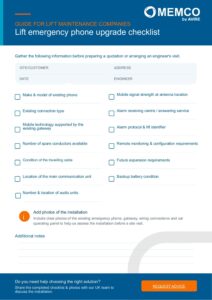
Download our lift emergency phone upgrade checklist to gather the information needed before preparing a quotation or arranging an engineer’s visit.
Use it to review the existing equipment, available wiring, mobile signal, backup battery, answering service and remote management requirements.


Test calls can fail because of poor mobile coverage, SIM or service issues, incorrect settings, loss of power, battery deterioration or incompatible receiver settings. Check the equipment, connection and receiving system, and establish whether the call failed or its result was not recorded.
The alarm system sends an identifier that the receiving system associates with a building and individual lift. After changing the phone, gateway, SIM or alarm destination, make a test alarm call and confirm that the correct installation details are received.
Record the phone and gateway make and model, connection type, mobile voice capability, available wiring, cable condition, signal strength, backup power, audio points and answering service. Include any network migration timetable, remote management needs and planned expansion.
Consider:
- Available wiring
- Building use and number of lifts
- Connection type and mobile coverage
- Required audio points
- Monitoring requirements
- Answering-service compatibility
- Backup power and maintenance needs
No. Compare the installed and ongoing costs, including cable work, commissioning, SIM and service charges, batteries and maintenance visits. A lower equipment price can be offset by additional installation or support work.
Depending on the equipment and architecture selected, DCP-based systems can support connected audio units and monitoring functions. Confirm the device limits, interfaces, wiring and power requirements for any proposed expansion before specifying the system.
Yes. Share the survey findings with our UK team to discuss suitable gateway, audio and monitoring options. Include the existing phone, available conductors, required alarm points and answering-service details so that compatibility can be assessed.
Plan an upgrade before its connection is migrated or withdrawn, or when recurring faults, poor audio or incorrect identification prevent dependable communication.
For PSTN-connected systems, confirm the individual line’s migration date and complete commissioning before that change. Do not wait for the national 31 January 2027 deadline.
Potentially, if it remains suitable for the installation and works with the proposed gateway and answering service.
Test voice, lift identification, automatic test calls and backup power as a complete system. For a mobile upgrade, verify that the gateway, SIM and service support VoLTE voice calls.
Ask the supplier to assess the conductors against the complete system design. Cable reuse depends on condition, length, architecture and connected devices.
Do not assume that a product described as two-wire supports all required audio units, indicators and future additions through the same pair.
Which communication system does each lift need?
The right solution depends on the existing equipment, connectivity and scope of the upgrade.
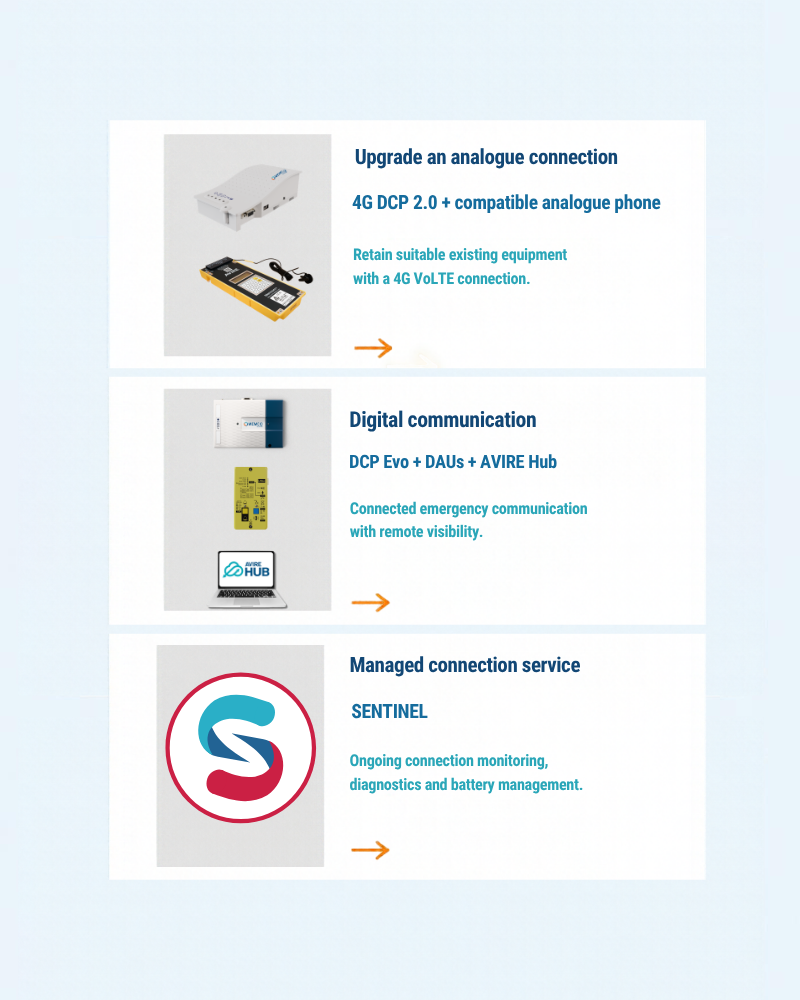
A serviceable analogue phone may be retained, while another installation may need new audio units and greater remote visibility. Limited wiring can be a separate constraint in either case.
MEMCO by AVIRE offers UK products and support for these scenarios:
- Connection upgrade: assess 4G VoLTE DCP 2.0 with a compatible existing analogue phone where retention is appropriate.
Digital communication and monitoring: assess DCP Evo with compatible DAUs and AVIRE Hub, using VoLTE or VoIP as appropriate to the installation and service.
Restricted wiring: ask our UK team to assess the survey and confirm a suitable arrangement before specifying cable reuse or changes.
Need to upgrade an installation?
An accurate survey helps identify wiring changes, compatibility issues and commissioning requirements before work starts.
Send us details of the current emergency phone and gateway, available wiring, connection and required audio points. The MEMCO by AVIRE UK team can help assess which communication arrangement suits the installation.
Contact our team to discuss your project.