











The digital switch is already taking place across the UK.
The digital switch refers to the ongoing changes to the UK telecoms network in which fibre lines are being rolled out across the country to replace copper lines.
This means the end of analogue (PSTN and ISDN) telephone services and the transition to fibre optic lines. While this is great news for internet speed, the digital switch will have a huge impact on key safety devices that will no longer be supported, including lift emergency phones.
Read more about the digital switch in our full guide which discusses the transition from analogue to fibre.
We are proud to support the Fit to Switch campaign as a National Champion Sponsor, and are committed to raising awareness about the PSTN switch-off and its imminent impact on critical lift emergency communications.
The Digital Switch and Lift Alarms | Official DSIT Guidance
The UK is preparing for the retirement of the Public Switched Telephone Network (PSTN), which will be fully switched off by January 2027. This change affects all services that currently rely on analogue phone lines, including lift emergency alarm systems.
To support building owners, facility managers, and the lift industry, the Department for Science, Innovation and Technology (DSIT), in collaboration with the Lift and Escalator Industry Association (LEIA), has released an official letter with impartial guidance on the transition.
Learn how to prepare lift emergency communications for the digital transition with guidance from a telecom expert.
AVIRE solutions for the Digital Transition
Whether you’re protecting current lift lines through the transition with a managed service such as SENTINEL, or progressing to a full digital communications platform for long-term resilience, AVIRE’s approach ensures continuous, compliant two-way voice coverage across all critical lift locations.
Ensure resilience of emergency telephones in lifts
The change from copper to fibre lines will affect the resilience of lift emergency phone lines – particularly during power failures, which is the most likely time when an entrapment may occur. Discover UK’s only pro-actively managed, resilient lift emergency connection service: SENTINEL.

Upgrade lift communications for the digital transition
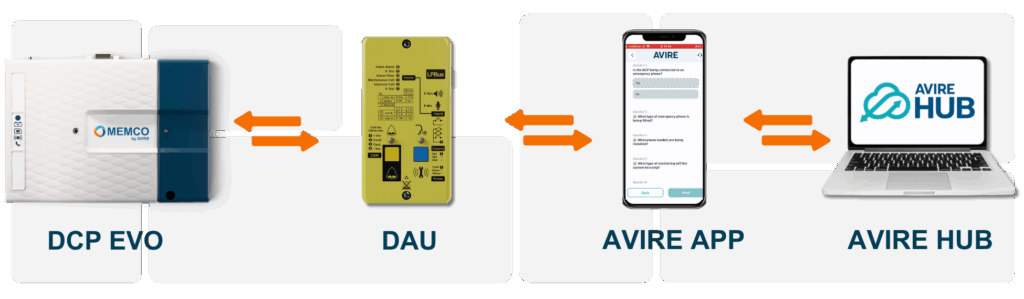
As copper networks are withdrawn, lift emergency systems must move to digital connectivity to remain operational and compliant. Discover AVIRE’s fully digital lift communication solution, providing resilient voice coverage to the lift car, pit, top of car and machine room without reliance on analogue lines.
Navigating the digital switch over
Tobias, a Telecommunications Engineer, sees the risks of the switch-off, so he’s offering reliable digital services to keep customers connected.
Bridgette, a Building Portfolio Manager, recognises the compliance challenges, so she’s ensuring her lifts stay safe and digitally connected.
Liam, a Lift Service Technician, knows analogue systems are becoming obsolete, so he’s upgrading to secure digital solutions.
What’s the timeline?
The Digital Switch is currently underway and national stop sell of analogue lines is now in force.
Stop sell essentially means the end to new analogue services, but that’s not all…
…it also means that under the following conditions you’ll get fibre (whether you asked for it or not)!
- Change of communication provider (aka “name on your bill“)
- Working line take over (“lines moving between owners”)
This means you may already have fibre lines supporting your lifts.
“Around 100 days remain until the PSTN is retired on 31 January 2027. Businesses should review their estates now to identify any critical services, including lift alarms, that may still rely on legacy lines.
John Livermore, Industry Engagement Manager, All-IP and Exchange Exit, Openreach
Identifying the line is only the first step. Businesses should speak to both their communications provider and lift maintenance provider, confirm that the proposed replacement is compatible, and test the complete emergency communication pathway after migration.
Leaving this work until the final weeks risks avoidable service disruption and could make it more difficult to secure the necessary engineering support. The message is simple: review, test and switch well ahead of the deadline.”
Openreach Full Fibre rollout in the UK
Openreach has produced the useful interactive map below to show their full fibre rollout around the UK.
Data source: Live data feed provided by www.openreach.co.uk.
While this map provides a high-level view based on exchange areas rather than individual premises, it’s a useful starting point for identifying which sites may be affected by the digital switch. It can help you prioritise where to investigate further and take early action.
Analogue Switch Off in the UK
FAQs

The Digital Switch is the UK-wide transition from analogue copper telephone networks (PSTN/ISDN) to digital, IP-based services delivered over fibre. The legacy analogue network is being permanently withdrawn.
The PSTN network is scheduled to be fully retired by January 2027, with regional migrations already underway. Service providers are progressively moving customers to digital alternatives.
You can use the Openreach postcode map as a starting point to identify areas where full fibre rollout is already advanced. While this is only a high-level indicator, it can help you prioritise which sites to investigate and audit first.
Yes. Lift emergency telephones that rely on analogue lines may stop functioning reliably once those lines are withdrawn or converted to digital services without proper compatibility measures, often without any visible warning.
Traditional copper lines carried their own power from the exchange. Digital fibre services do not, meaning additional resilience measures are required to maintain lift emergency communications during power failures.
A practical first step is to carry out an audit of your lift communication systems. This helps you identify which lifts still rely on analogue lines, understand how emergency calls are routed, and prioritise sites that need attention.
Without this visibility, issues are often only discovered when something fails, making early action much more difficult.
In many cases, yes. To maintain safe and compliant two-way emergency communication, analogue systems must either be protected with resilient connectivity services or upgraded to fully digital communication platforms.
A key first step is to audit your lift communication systems to understand which lifts are affected and prioritise upgrades.
Many sites choose to combine both approaches, using managed resilient connectivity to maintain continuity during the transition, while implementing fully digital lift communication systems for long-term reliability and compliance.
Starting early allows you to plan this transition properly and avoid reactive upgrades later.