











PSTN ‘Landlines’ or analogue lines are used widely to provide connectivity for emergency lift communications systems, to meet the needs of EN 81-28. These services will be ceased on 31st January 2027 as a result of the UK’s telephone network – the Public Switched telephone Network -(PSTN) closing down.
Accordingly, to maintain your clients’ compliance, they need to be migrated to a new communications products.
Talking with your client now is urgent, as putting in place alternate arrangements may be a lengthy process, especially for large lift estates.
Yes. The COP DAU is suitable for modernising existing lifts when sufficient space is available behind the car operating panel and the required components can be integrated.
Yes. An optional inductive loop is available to support passengers with hearing aids.
Yes. Both units are designed to connect to AVIRE’s Digital Communications Platform as part of a digital lift emergency communication system.
COP DAU stands for Car Operating Panel Digital Audio Unit. It is installed behind the car operating panel and provides the audio connection for the lift emergency communication system.
TOC DAU stands for Top of Car Digital Audio Unit. It is installed on top of the lift car and provides an accessible emergency communication and alarm point.
Test calls can fail because of poor mobile coverage, SIM or service issues, incorrect settings, loss of power, battery deterioration or incompatible receiver settings. Check the equipment, connection and receiving system, and establish whether the call failed or its result was not recorded.
• User admin – can create new users and manage their access levels.
• User standard – cannot set up new users.
• User read-only
• Users can also be set up to see contract specific installations only. For example, restricted access can be given to a building manager.
The web interface and all customer facing APIs use HTTPS (TLS v1.2) and require user authentication. In HTTPS the communication protocol is encrypted using a using Transport Layer Security (TLS), or, formerly, its predecessor, Secure Sockets Layer (SSL). The protocol is therefore also often referred to as HTTP over TLS, or HTTP over SSL.
Yes. The TOC DAU is suitable for lift-group installations. The number of lift cars that can be connected will depend on the DCP and overall system configuration.
A COP DAU is generally the better choice when sufficient space is available behind the car operating panel and a compact, fully integrated installation is preferred.
PSTN ‘Landlines’ or analogue lines are used widely to provide connectivity for emergency lift communications systems, to meet the needs of EN 81-28. These services will be ceased on 31st January 2027 as a result of the UK’s telephone network – the Public Switched telephone Network -(PSTN) closing down.
Accordingly, to maintain compliance, these lines need to be changed out to new communications products.
Taking action now is urgent, as putting in place alternate arrangements may be a lengthy process, especially for large lift estates.
The Telephone network in the UK, based upon the Public Switched telephone Network (PSTN) is closing down. This affects ‘landlines’, which are used widely to provide connectivity for emergency lift communications systems. This is happening at the end of January 2027, and post that date, all existing lines will be terminated. This is often known as the Analogue to Digital switch, moving from a tone-based call set up and signalling arrangement to an Internet Protocol (IP) based solution.
Acting now means that alternative arrangements can be made in time, avoiding risk to passenger safety and compliance.
SENTINEL provides managed, monitored lift connectivity with roaming SIM resilience, extended battery backup, and automated alerts via AVIRE HUB, helping you identify issues before they become incidents.
Analogue PSTN lines are often used in lifts to provide the emergency communications necessary to meet the needs of British Standard EN 81-28, a standard for remote alarm systems on passenger and goods passenger lifts. It ensures trapped users can summon help, mandating 24/7 monitoring and emergency battery power.
These devices use DTMF signalling for call set up and mid call. With PSTN switch off, replacement products need to be provided to ensure ongoing compliance to the standard.
FTTP products may be available, and an availability check will be necessary to confirm that an order can be taken for the point of use, which is often the lift comms. room.
Fibre To The Cabinet (FTTC)-based products, like Openreach’s Single Order Generic Ethernet Access (SOGEA) may be available, but the power back up arrangements at the FTTC cabinet need to be risk assessed, as SLAs/SLGs are not currently provided to cover the scenario of a localised (to the cabinet) power failure for this product.
Solutions using IP products connected to an Analogue Telephone Adapter (ATA) or an Analogue to Digital (A2D) converter should be treated with caution, and generally wouldn’t be recommended, unless rigorous testing had been successfully concluded. The reason for this is that they have been shown to work inconsistently, if at all.
Whatever the solution offered, it is recommended these are thoroughly tested in conjunction with the supplier of the emergency lift device.
For consistency of operation across the UK, the best option is to move to a Cellular-based solution.
The Telephone network in the UK, based upon the Public Switched telephone Network (PSTN) is closing down. This affects ‘landlines’, which are used widely to provide connectivity for emergency lift communications systems. This is happening at the end of January 2027, and post that date, all existing lines will be terminated. This is often known as the Analogue to Digital switch, moving from a tone-based call set up and signalling arrangement to an Internet Protocol (IP) based solution.
Acting now means that alternative arrangements can be made in time.
Yes. Both products are designed for use within lift emergency communication systems that comply with EN 81-28. Compliance will depend on the design, installation and configuration of the complete system.
The principal difference is the installation location. The COP DAU is fitted behind the car operating panel, while the TOC DAU is installed on top of the lift car. Both provide the core audio function required by a digital lift emergency communication system.
A TOC DAU is generally the better choice when there is limited space behind the car operating panel, access to the panel is difficult or the equipment needs to remain easily accessible for maintenance. It is also particularly suitable for lift groups.
• The web interface and all customer facing APIs use HTTPS (TLS v1.2) and require user authentication.
• The AVIRE HUB is hosted in Azure, which is used by many high-profile organisations.
• MySQL is the database engine which has unparalleled security and global reach.
• Unwanted incoming and outgoing connections are blocked by a secure firewall that is monitored on a daily basis. Only specified connections are allowed through our secure firewall.
• Protections include username, password and a certificate required for access to the AVIRE HUB
No, the DCP can work with any SIM card of the correct size with appropriate voice/data, however we recommend using Avire roaming SIMs as they have been preconfigured on the DCP to connect to the Avire HUB monitoring.
For applications using small amounts of data and voice, as is the case with most elevator emergency telephones, specific M2M SIMs usually provide a better deal compared to consumer SIM cards. Consumer SIMs will have large amounts of data and voice, generally not required for most M2M applications and Pay As You Go SIM Cards need regular checking to make sure they are in credit.
M2M SIM Cards also provide enhanced security and are designed to be managed easily across many devices. There are also additional benefits such as they will generally not switch off during periods of extended inactivity.
Please contact our team for more information on AVIRE’s SIM Cards.
A CANbus splitter is a Avire device can be used to divide the CAN line.
When more than one lift shares a Digital Communication Platform (DCP), the “endpoints” can be more difficult to identify. AVIRE’s CAN devices have ‘optional’ terminator resistors which can be set using the SW1 switch on the device as shown below. Please refer to the individual product installation guides (including Lift Hawk, Navbox and Connex-02) for more information.
When more than one lift shares a Digital Communication Platform (DCP), the “endpoints” can be more difficult to identify. AVIRE’s CAN devices have ‘optional’ terminator resistors which can be set using the SW1 switch on the device as shown below. Please refer to the individual product installation guides (including Lift Hawk, Navbox and Connex-02) for more information.
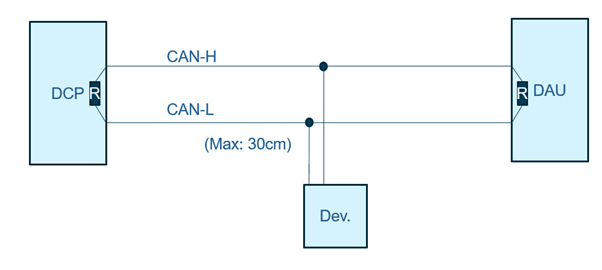
Typically, in the AVIRE Ecosystem, the DCP is one endpoint located in the machine Room and the other is the DAU located in the car. All other devices must be attached in parallel to the CANBus as shown in the diagram below.
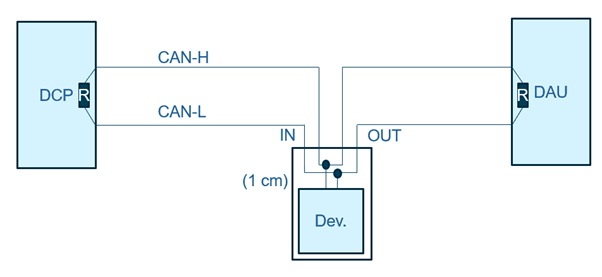
To make life easier, all of our CAN devices have a CAN-IN and CAN-OUT terminal. This ensures that every node is close to the main bus (< 30cm). This is illustrated in the diagram below.
There are a couple of key factors you need to consider when using a CANbus protocol to ensure that interference is kept to a minimum.
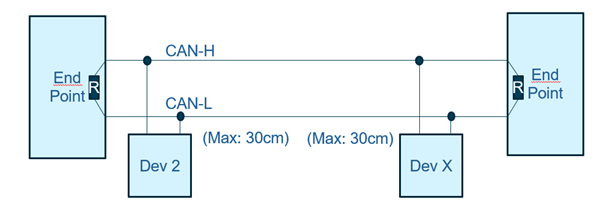
• The endpoints MUST have the termination resistor.
• All other devices must be closer than 30cm to the main ‘BUS’.
CANbus (Controller Area Network) is a vehicle bus standard designed to allow smart devices (or nodes) to communicate. Designed by Robert Bosch back in the 80’s, it was initially used by car manufacturers.
The bus is based in a serial transmission (digital data is sent bit by bit over time) using a differential voltage across a single pair of wires.
To learn more about CANbus, you can read our insights article: What is CANbus?
CAN does not send large blocks of data point-to-point from node A to node B. CAN network sends many short messages which are broadcast to the entire network.
All nodes can transmit information to other nodes in the same bus and any node can be transmitter or receiver.
There are many reasons why we use CANbus at MEMCO by AVIRE:
• Low cost: Devices/nodes communicate via a single CAN interface not through direct analogue signal lines, therefore, reducing wiring errors and cost.
• Robust: The system has a robust physical layer, designed for high noise and other challenging environments.
• Centralised: The CAN bus system allows for central error diagnosis and configuration across all devices/nodes
• Flexible CAN messages are prioritised via IDs so that the highest priority IDs are non-interrupted.
There are some inherent limitations with CANbus, and these include the following:
• A maximum number of nodes is not specified for the network but typically it supports up to 64 nodes due to electrical loading.
• Undesirable interactions between nodes can occur where one node talks and can disturb the other nodes.
• The network needs to follow a certain architecture to achieve the best results.
• In order to reduce signal integrity issues such as reflections, CAN bus should be properly terminated at both the ends with resistors.
• There is also a limitation of speed of data transmission when the distance is increased. At 200mts the speed is limited to 200Kbps.
Internet Protocol. A packet-based protocol for delivering data across networks.
GSM stands for Global System for Mobile Communication. The DCP stands for Digital Communication Platform and combines the GSM with the lift emergency telephone and machine to machine gateway.
The DCP has a power source and one internal battery capable to power a limited number of CAN devices (200mA max). When there are a number of CAN devices connected to the DCP it is necessary to add an additional power supply. As a rule of thumb, when a CAN splitter is needed, an extra power source may be required.
A GSM unit is voice only, whereas GPRS is voice and data.
Dual-tone multi-frequency
The tones that are heard when you press the buttons on a touch-tone telephone and allows you to send data via PSTN (analogue telephone line). DTMF assigns a specific frequency (consisting of two separate tones) to each key. This is also the system that most emergency analogue telephones use to transfer information e.g., background call information.
A CANbus splitter is required when you have multiple devices that need to be connected to the Digital Communication Platform (DCP). A CANbus splitter has 5 CAN ports and any data present in one CAN port is replicated by the CAN Splitter to all other CAN busses. Each CAN port is an endpoint with its own resistor as shown in the diagram below.
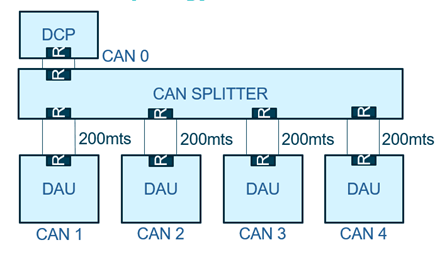
Architect example: CANbus Splitter used on a Duplex Lift installation.
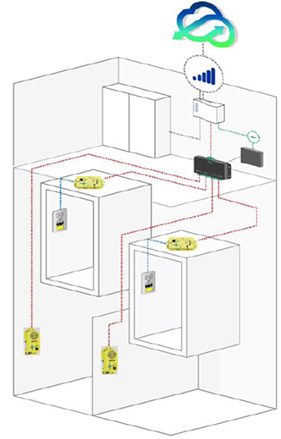
No, The DCP has two functions, a telephone line for the Memcom Autodialler or when used with the Avire ECO system CANbus range (DAU/PIT) the DCP can be used as a Autodialler to create your full emergency telephone system.
A roaming SIM is a mobile SIM card that will connect to more than one network within its home country, if a network carrier goes down or a signal cannot be gained from one network, it will automatically switch to the next strongest signal from one of the other networks available.
This means that you should never lose signal, assuming there is coverage by at least one network, and provides maximum security of connection. Most consumer SIMs do not roam within their own country and use one network- if there is an area that is not covered by that network, or that network fails, signal is lost.
An AVIRE SIM is an M2M (machine to machine), managed, non-steered roaming SIM. Consumer sims usually cater for regular human interaction and only use or prefer one provider. AVIRE SIM’s on the other hand are designed for machine to machine communication with the ability to connect to multiple providers.
AVIRE’s SIM Cards are preactivated and automatically work with the DCP. This saves time when programming the DCP.
Many consumer roaming SIMs are Steered Roaming SIMs which means they will have a preferred network that the SIM will connect to if available, even if it is not the strongest. It is only when the signal drops below a certain level that the signal will switch to a different network. When a SIM is non-steered, like the AVIRE SIM, this means that they will always connect to the strongest network available and therefore guarantee maximum strength of connection.
M2M, which stands for machine to machine, generally refers to communication between two devices, with no human interaction. An M2M SIM card is primarily used for sending and receiving data; not for voice and SMS, however you can get voice and SMS messages included in the package. When thinking about SIMs in terms of Internet of Things (IoT), M2M is really about the communication between the devices. For more information on M2M SIM cards, please read: (link)
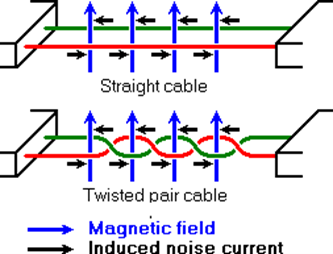
In any installation, a cable can act as an antenna and the noise on the cable increases with the increased length of the cable and with the increased enclosed area of the cables. Shorter cables and the closer the wires are together will improve the noise reduction on an installation.
In a twisted pair, the long antenna is divided by many smaller antennas that work in opposite ways. The noise captured by one antenna is subtracted by the noise captured by the other.
No. The Avire DCP is purpose built, designed to work with the Avire CANbus devices.
You can program the DCP in a variety of ways using the Avire HUB, SMS or via an analogue Handset plugged through the DCP telephone port (please see DCP installation guide for more details)
The easiest option is by first by configuring APN setting through SMS text message and then using the AVIRE HUB to complete the configuration process.
With the Antenna and sim connected power the device with the internal battery until DCP LED’s status are correctly shown after 2 mins, then switch the SW1 dip switch 1 to ON (Default: OFF). Once you’ve checked that location is acceptable then turn SW1 to OFF and fasten into position. In cases where the DCP is installed on top of the lift car ensure that unit is checked at every floor level to see if the installation is suitable for a top of car mounting.
How many lifts can a Digital Communication Platform (DCP) be used as part of the ECO system?
It is possible to use one DCP on a bank of four lifts max. (CANbus address will need to be selected through the device)
We advise that the DCP is installed where signal strength is the greatest either in a machine room or at the top of the lift shaft. In cases where signal strength is strong throughout the lift shaft then in some cases the DCP can be installed on top of the lift car. If you have any doubts regarding the signal strength, the DCP signal tester should be used before securing the unit.
As PSTN switch off gets nearer, checks should be made with the end customer in order to determine the use-case of the lines, as simply migrating a PSTN line to, for example SOGEA, is not appropriate.
Care must be taken to ensure that the emergency lift line continues meet the needs of the standard through the migration. Communication Providers should be aware of the need to protect life and limb, and the question of legal liability.
The alarm system sends an identifier that the receiving system associates with a building and individual lift. After changing the phone, gateway, SIM or alarm destination, make a test alarm call and confirm that the correct installation details are received.
No. Managed connectivity supports lift contractors by ensuring the emergency communication pathway remains operational. Mechanical servicing, safety inspections, and contract responsibility remain with you.
Building owners and managing organisations are responsible for ensuring lift emergency communication systems remain operational and compliant. This includes maintaining a reliable voice path and ensuring resilience during power outages or network changes.
The UK PSTN network is being withdrawn by January 2027. Any lift emergency system relying on analogue infrastructure may become non-operational if migrated without proper adaptation and resilience planning.
If lifts use PSTN ‘Landlines’ – often call Analogue lines – for communications by the in-car emergency console, they will stop working at the end of January 2027. An alternative ‘Digital’ communications solution will be necessary in order to ensure ongoing compliance.
The Digital Switch is the UK-wide transition from analogue copper telephone networks (PSTN/ISDN) to digital, IP-based services delivered over fibre. The legacy analogue network is being permanently withdrawn.
Yes, provided the solution maintains a continuous two-way voice path, supports power resilience, and enables automated testing in line with EN 81-28 and relevant guidance.
It’s important to ensure that alternative solutions work as required in a consistent manner. If a fixed line IP based alternative is chosen, that should be allied with a change of hardware to achieve an end-to-end digital solution.
The use of analogue to digital converters, to avoid the need to replace hardware is not recommended as these have been proven not to work consistently across different Communication Provider’s Fibre To The Premises (FTTP) access networks.
This however may not even be possible as a fixed line circuit, like FTTP, may not be available to the premises/lift.
Cellular solutions, based upon 4G or 5G offer the most flexible and consistent solutions UK-wide.
The recommendation is to test thoroughly whatever solution is proposed, to include fallback arrangements due for example to a localised power failure.
Record the phone and gateway make and model, connection type, mobile voice capability, available wiring, cable condition, signal strength, backup power, audio points and answering service. Include any network migration timetable, remote management needs and planned expansion.
Autodiallers with PSTN lines use a signalling protocol known as Dual Tone Multi Frequency (DTMF). These signals are used during call set up, during a call and at call closure. They are designed to work over analogue networks and do not readily work in a digital or IP environment.
Alternate solutions need to work in a consistent manner across all Communication Provider networks. The use of analogue to digital converters, to avoid the need to replace hardware is not recommended as these have been proven not to work consistently across different Communication Provider’s access networks.
Digital, IP or cellular services require local power, because power is not fed down ‘the line’. In a localised power cut this means service will stop working unless a battery backup or UPS or in place.
For lifts with PSTN lines, the line will stop working, plain and simple. This will mean the lift is no longer compliant with EN 81-28, putting building users at risk and exposing housing providers/building owners and FM operators to inspection failures, legal liability, and urgent, costly retrofits.
Autodiallers with PSTN lines use a signalling protocol known as Dual Tone Multi Frequency (DTMF). These signals are used during call set up, during a call and at call closure. They are designed to work over analogue networks and do not readily work in a digital or IP environment.
Alternate solutions need to work in a consistent manner across all Communication Provider networks. The use of analogue to digital converters, to avoid the need to replace hardware is not recommended as these have been proven not to work consistently across different Communication Provider’s access networks.
Digital, IP or cellular services require local power, because power is not fed down ‘the line’. In a localised power cut this means service will stop working unless a battery backup or UPS or in place.
The PSTN network is scheduled to be fully retired by January 2027, with regional migrations already underway. Service providers are progressively moving customers to digital alternatives.
Lift alarm lines typically show low usage patterns with periodic automated test calls. Reviewing line purpose before migration helps prevent unintended service disruption.
For lifts with PSTN lines, the line will stop working, plain and simple. This will mean the lift is no longer compliant with EN 81-28, putting building users at risk and exposing you to inspection failures, legal liability, and urgent, costly retrofits.
You can use the Openreach postcode map as a starting point to identify areas where full fibre rollout is already advanced. While this is only a high-level indicator, it can help you prioritise which sites to investigate and audit first.
Unexpected communication failures can lead to emergency engineer dispatches, reputational impact, and contractual risk if emergency services are disrupted.
Moving to a managed connectivity solution has no impact on the complexity of the solution. Indeed, they will bring additional benefits through central monitoring of each lift, identifying & initiating remedial action to any faults that arise. This means engineers can focus on their core responsibility – mechanical and safety servicing.
Possibly. Fibre networks are primarily being built to meet the needs of residential consumers – and the needs of businesses have not really been considered, although some network builders have looked to fix this in specific geographies, or where a specific contract has been let. If fibre has been built to a building, it’s not guaranteed that it’s available to service the needs of the emergency lift lines – in terms of capacity being available, or being pre-built to a suitable connection point in a lift room.
Communication Providers should know the answer to this question, but if there’s not a definitive ‘Yes’ (in being available to a lift room and ready to take an order), then count on long delays and increased provision costs to get service.
For consistency of operation across the UK, the best option is to move to a Cellular-based solution, like SENTINEL from MEMCO by AVIRE.
Consider:
- Available wiring
- Building use and number of lifts
- Connection type and mobile coverage
- Required audio points
- Monitoring requirements
- Answering-service compatibility
- Backup power and maintenance needs
Maybe. Do bear in mind that Communications Providers’ businesses are focussed on the provision of Broadband and standard Telephony – they don’t typically know the use-case for any of the lines that they provide. Accordingly, you should be proactive and help your clients engage with their Communication Providers to ensure a smooth migration.
Traditional copper lines carried their own power from the exchange. Digital fibre services do not, meaning additional resilience measures are required to maintain lift emergency communications during power failures.
Yes. Lift emergency telephones that rely on analogue lines may stop functioning reliably once those lines are withdrawn or converted to digital services without proper compatibility measures, often without any visible warning.
A managed approach, like SENTINEL from Memco by Avire, centralises monitoring, SIM resilience, and battery oversight, reducing reactive support and providing proactive fault visibility.
A defensible approach includes power-backed connectivity, proactive monitoring, clear testing capability, and documented system performance that can be evidenced during audit or review.
No. Compare the installed and ongoing costs, including cable work, commissioning, SIM and service charges, batteries and maintenance visits. A lower equipment price can be offset by additional installation or support work.
PSTN lines benefit from power being provided down the line from telephone exchanges, meaning that in the event of a power cut, these lines continue to function. Digital fixed line and cellular solutions require local powering and so power back-up must be implemented to maintain compliance in the event of a power cut.
Absolutely, in higher-risk environments.
If a fixed line solution is available, then a back-up cellular route would be recommended, whereas in cellular-only solutions, a dual path option with multi-SIMs would be recommended. Either way, knowing that a fallback option was being used must be visible to operational control in order that remedial work can be undertaken to restore service to the primary route.
With a managed service, SIM status and battery resilience are monitored automatically. Alerts are issued if an issue arises, reducing the need for manual checks.
No. Managed lift connectivity is designed to integrate alongside existing managed voice portfolios, extending service capability rather than replacing core infrastructure.
A practical first step is to carry out an audit of your lift communication systems. This helps you identify which lifts still rely on analogue lines, understand how emergency calls are routed, and prioritise sites that need attention.
Without this visibility, issues are often only discovered when something fails, making early action much more difficult.
Depending on the equipment and architecture selected, DCP-based systems can support connected audio units and monitoring functions. Confirm the device limits, interfaces, wiring and power requirements for any proposed expansion before specifying the system.
Yes. Share the survey findings with our UK team to discuss suitable gateway, audio and monitoring options. Include the existing phone, available conductors, required alarm points and answering-service details so that compatibility can be assessed.
In many cases, yes. To maintain safe and compliant two-way emergency communication, analogue systems must either be protected with resilient connectivity services or upgraded to fully digital communication platforms.
A key first step is to audit your lift communication systems to understand which lifts are affected and prioritise upgrades.
Maybe. Do bear in mind that Communications Providers’ businesses are focussed on the provision of Broadband and standard Telephony – they don’t typically know the use-case for any of the lines that they provide. Accordingly, you should seek out your Communication Providers to understand their proposals for ensuring your continuity of operation.
Lift emergency communication should maintain a continuous two-way voice path, operate during power loss, and support automated testing aligned with EN 81-28 requirements.
Basic GSM units can lose signal, SIMs may expire, and faults often go unnoticed until tested. SENTINEL uses roaming SIMs to find the strongest network, includes extended battery backup, and provides 24/7 monitoring via the AVIRE HUB.
Managed services provide ongoing monitoring and fault visibility, helping consultants specify solutions that remain operational beyond initial commissioning.
PSTN lines benefit from power being provided down the line from telephone exchanges, meaning that in the event of a power cut, these lines continue to function. Digital fixed line and cellular solutions require local powering and so power back-up must be implemented to maintain compliance.
Connectivity management is designed to complement service contracts by reducing communication-related faults and protecting performance against avoidable failures.
In unmanaged systems, housing providers often end up responsible. With SENTINEL, both are monitored automatically, and alerts are sent if there is a problem. This means you don’t have to worry about checking or replacing them yourself.
Plan an upgrade before its connection is migrated or withdrawn, or when recurring faults, poor audio or incorrect identification prevent dependable communication.
For PSTN-connected systems, confirm the individual line’s migration date and complete commissioning before that change. Do not wait for the national 31 January 2027 deadline.
Many sites choose to combine both approaches, using managed resilient connectivity to maintain continuity during the transition, while implementing fully digital lift communication systems for long-term reliability and compliance.
Starting early allows you to plan this transition properly and avoid reactive upgrades later.
Yes. Managed lift connectivity enables providers to extend critical communication services into safety-regulated environments while reducing migration-related risk exposure.
By reducing communication failures and improving visibility, managed connectivity helps contractors maintain service reliability and strengthen long-term client relationships.
A fibre line may be available. Fibre networks however have primarily been built to meet the needs of residential consumers – and the needs of businesses have not really been considered, although some network builders have looked to fix this in specific geographies, or where a specific contract has been let. If fibre has been built to a building, it’s not guaranteed that it’s available to service the needs of the emergency lift lines – in terms of capacity being available, or being pre-built to a suitable connection point in a lift room.
Communication Providers should know the answer to this question, but if there’s not a definitive ‘Yes’ (in being available to a lift room and ready to take an order), then count on long delays and increased provision costs to get service.
For consistency of operation across the UK, the best option is to move to a Cellular-based solution, like SENTINEL from Memco by Avire.
No. Connectivity management complements lift maintenance by ensuring the communication pathway remains operational, while mechanical and safety servicing remain with the maintenance provider.
Potentially, if it remains suitable for the installation and works with the proposed gateway and answering service.
Test voice, lift identification, automatic test calls and backup power as a complete system. For a mobile upgrade, verify that the gateway, SIM and service support VoLTE voice calls.
Lift emergency communications should be considered critical infrastructure and aligned with broader building digital migration plans, rather than treated as isolated legacy lines.
Yes. SENTINEL supports EN 81-28 requirements by maintaining a two-way communication path, automated test capability, and power resilience, helping keep your lifts compliant.
Yes. SENTINEL meets EN 81-28 requirements with power resilience, automated test calls, and fault alerts, keeping your lifts compliant and safe.
Find out what comms. solution(s) are in place today and if they’re PSTN. If you struggle to find out, speak to the client or FM lead. It could be that a phone bill might need to be examined, or ask us at Memco by Avire.
If PSTN is used, we can manage the whole update from a single lift with no redundant connectivity up to multi-sites with fully backed up solutions.
Key though is to act now. Time is short and resources will be constrained further as the deadline approaches.
No. SENTINEL supports lift maintenance providers by ensuring the communication pathway remains resilient and monitored. Mechanical servicing and lift safety responsibilities remain with your contractor.
Ask the supplier to assess the conductors against the complete system design. Cable reuse depends on condition, length, architecture and connected devices.
Do not assume that a product described as two-wire supports all required audio units, indicators and future additions through the same pair.
SENTINEL is installed by your current lift maintenance provider, with AVIRE providing the technology, monitoring, and ongoing support.
Here at Memco by Avire, we’ve been working on PSTN switch off for years. We’ve migrated thousands of lines and have a great solution we’d like to talk to you about, be that for a single lift up to a significant estate.
We’re working with the leading experts in the field and so can answer any questions or concerns you may have.
Yes. SENTINEL is 4G-ready, uses managed SIMs, includes battery backup, and is supported by AVIRE HUB, ensuring reliability now and beyond the PSTN switch-off.