









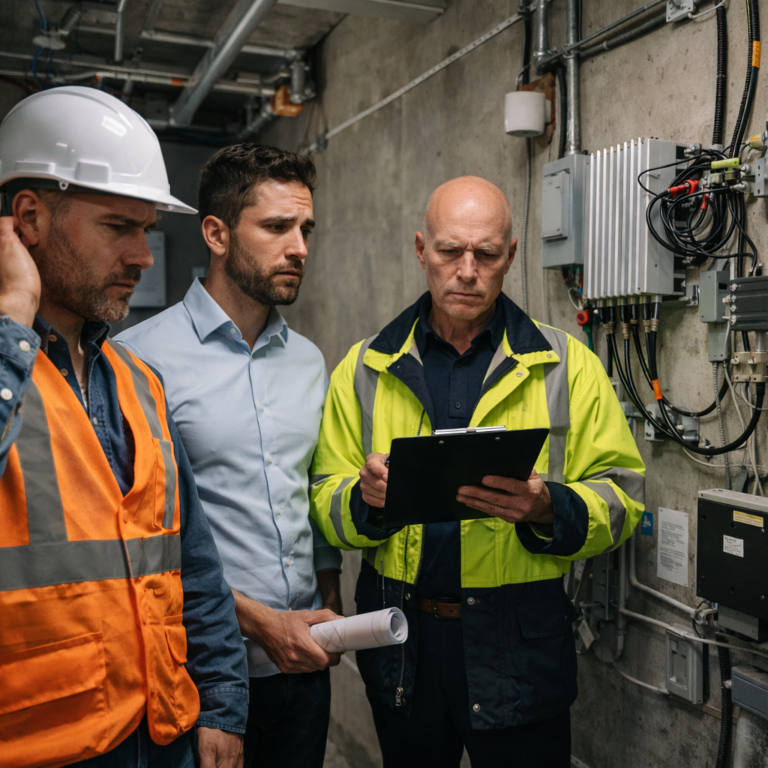
Public Safety DAS (Distributed Antenna Systems) have become an essential part of modern commercial building design.
As construction materials continue to impact in-building radio coverage, these systems help ensure first responders can communicate reliably throughout a facility during an emergency.
While the technology itself is well established, successfully deploying a Public Safety DAS requires more than selecting the right equipment. System performance, code compliance, installation quality, testing, and coordination all play a role in determining whether a project moves smoothly through inspection or experiences costly delays.
For contractors, engineers, system integrators, and building owners, understanding these challenges early can help reduce risk and improve project outcomes.
Start with Code Compliance
One of the most common causes of Public Safety DAS inspection delays and deployment challenges begins with code compliance. These systems must satisfy requirements established by the IBC, NFPA, UL, FCC, and local Authority Having Jurisdiction (AHJ). Together, these requirements establish standards for system performance, monitoring, survivability, documentation, and equipment certification.

Challenges often arise when these requirements are not fully considered during the design phase. Incomplete documentation, incorrect equipment selection, inadequate system monitoring, or misunderstandings of local AHJ requirements can all create issues during inspection. Even minor compliance gaps can result in additional testing, project delays, or costly corrective work.
Successful projects begin with a clear understanding of applicable codes and local requirements before installation starts. This includes selecting appropriately listed equipment, designing for required performance and survivability standards, and ensuring all documentation is complete and readily available throughout the inspection process. By making code compliance a priority from the beginning, project teams can reduce risk, improve inspection readiness, and avoid many of the challenges that lead to delays later in the project lifecycle.
Coordinate Early and Often
Public Safety DAS projects involve multiple stakeholders, including engineers, electrical contractors, low-voltage contractors, system integrators, building owners, and AHJs. Even when the system design is sound, project delays can occur when responsibilities are unclear or communication breaks down between teams. Common issues include:
- Installation timelines that do not align with other trades.
- Equipment locations changing during construction.
- Incomplete documentation handoffs.
- Delays in testing and commissioning activities.
Establishing clear ownership and maintaining regular communication throughout the project helps minimize these challenges and keeps projects moving toward inspection readiness.
Plan for Space and Infrastructure Requirements
Public Safety DAS equipment is frequently installed in electrical rooms, communication rooms, or other shared building spaces. As projects evolve, available wall space and infrastructure requirements can become more limited than originally anticipated. This can create challenges when accommodating multiple system components, battery backup equipment, cabling, and monitoring hardware.
Evaluating equipment footprints early in the design process can help prevent late-stage installation changes and reduce coordination challenges between trades. Systems that require fewer enclosures and interconnections can also help simplify installation and reduce the amount of space required.
Test at the Right Time
Testing is one of the most critical phases of any Public Safety DAS deployment. Coverage testing, system verification, monitoring validation, and documentation are essential to demonstrating compliance and preparing for inspection. A common mistake is conducting testing too early in the construction process.
As buildings progress toward completion, additional walls, windows, mechanical systems, equipment, furnishings, and other physical elements can significantly affect radio frequency propagation. Coverage results obtained during early construction may not accurately reflect system performance once the building is complete.
For this reason, testing should be conducted at the appropriate stage of construction and verified under conditions that closely represent the final building environment. Comprehensive testing should include:
- Signal strength verification throughout required coverage areas.
- System monitoring validation.
- Documentation of test results.
- Confirmation that all system components are fully operational.
Thorough testing helps identify issues before inspection and reduces the likelihood of costly rework.
Consider Long-Term System Reliability
Passing inspection is only one milestone in the life of a Public Safety DAS. Building environments change over time. Renovations, tenant improvements, new equipment, interior reconfigurations, and changes to radio network requirements can all affect system performance.
Designing with long-term reliability in mind helps reduce future service challenges and supports continued code compliance throughout the life of the building. This includes selecting equipment that simplifies maintenance, supports ongoing monitoring, and can adapt to future system requirements when necessary.
Simplifying Deployment Where Possible
While no single factor determines project success, reducing unnecessary complexity can help improve installation efficiency and simplify ongoing maintenance. Integrated solutions that combine key system components into a single enclosure can reduce wiring requirements, minimize equipment footprint, and simplify installation activities.
For example, the SAFE-1050 Integrated Public Safety DAS combines the Bi-Directional Amplifier (BDA) and Battery Backup Unit (BBU) into a single enclosure. This approach can help streamline deployment while reducing the number of components that must be installed, connected, and maintained on site.
Successful Public Safety DAS Projects Begin with Planning
Most Public Safety DAS inspection issues can be avoided through proactive planning, coordination, testing, and verification. Projects that establish code requirements early, maintain communication between stakeholders, perform thorough testing, and consider long-term system performance are often better positioned for successful inspections and smoother deployments.
As Public Safety DAS requirements continue to evolve, taking a strategic approach from design through commissioning remains one of the most effective ways to reduce project risk and improve outcomes.
Planning for Public Safety DAS?
If you are planning a project that requires a Public Safety DAS, early decision-making can have a significant impact on installation efficiency and inspection success.