









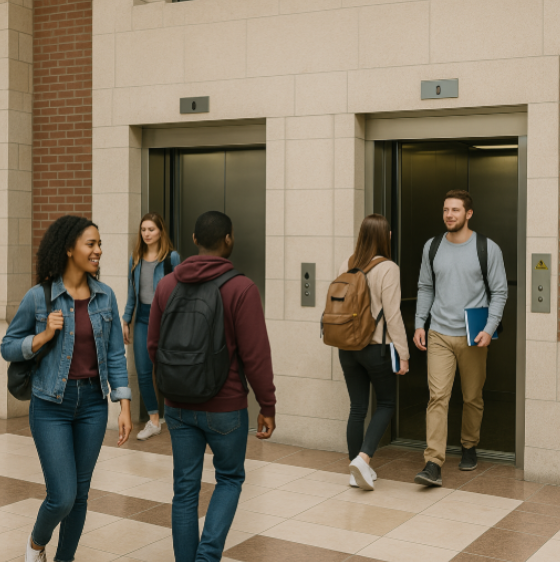
Every day, thousands of students, faculty and visitors move across campus using elevators, often without a second thought. When communication fails, an elevator stops between floors, or an emergency assistance button does not work – a moment of inconvenience becomes a major safety risk.
With growing pressure to improve campus security, accessibility, and emergency readiness, universities are rethinking how they protect their elevators. Many are discovering that outdated technology leaves critical gaps in both compliance and response.
A Campus Environment Creates Unique Safety Challenges
Unlike commercial high-rises, campus elevators support extremely diverse users. A single elevator bank may serve students with mobility challenges, faculty members transporting equipment, game-day crowds, or overnight maintenance crews. This mix of usage, combined with aging infrastructure and continuous renovation, means that universities face unique challenges in keeping elevator communication systems active, compliant, and accessible.
This renovation cycle creates an additional risk most universities don’t realize they have: each building may contain a different, proprietary elevator communication system. Over years of modernization, campuses end up with a mix of different devices – some dependent on analog lines, some partially compliant with accessibility requirements, and many that cannot be monitored consistently.
When something goes wrong inside an elevator, the emergency communication device is the only lifeline. If that call does not go through, if visual messaging is unavailable, or if the monitoring team is unaware that a system has already failed, the passenger inside has no way to receive help. In those moments, the difference between a safe outcome and a crisis comes down to whether the communication system works, and whether staff even know a device is offline.
Modern Elevator Safety Requires More Than a Phone
Today, a reliable system must connect instantly, support all passengers – including those who are deaf, hard of hearing, or non-verbal – and provide monitoring teams with clear visibility into the operational status of every elevator. Universities are discovering that many of their existing devices were not designed for these expectations.
Traditional analog phone lines are being phased out nationwide, which means many legacy elevator phones can appear operational but silently fail. Visual communication requirements are expanding under ADA, ASME, and local code adoption. Even when calls do reach an operator, response can be delayed if building staff do not have communication fault annunciators or machine room systems that help responders locate and support trapped passengers.
A Modern Solution for Campus Elevator Protection
RATH® and JANUS® systems offer a campus-ready approach to elevator safety that combines reliability, accessibility, and proactive prevention.
- Two-way voice and visual text communication systems ensure every passenger can communicate during an entrapment, even without the ability to speak or hear.
- Lobby and machine room systems provide immediate notification and clear response tools for public safety teams.
- Elevator phones are available for both modernization and new construction, and all solutions are built to meet or exceed current code requirements.
- Elevator door detection systems reduce shutdowns and prevent door strikes, which are one of the most common injury risks in high-traffic environments such as residence halls and athletics facilities.
- Elevator communication failure panels give campuses something they have historically lacked: instant visibility into the operational status of every emergency phone.
When a device loses connection, a visual alert appears so the problem can be fixed before a passenger is left without support.
Why Universities Are Modernizing Now
Compliance standards are evolving, and institutions must prove that their emergency communication systems meet accessibility and code requirements. At the same time, the sunset of traditional phone lines means that delaying modernization increases the likelihood of system failure.
Just as important, modernization allows campuses to consolidate fragmented proprietary systems into unified platforms. Without standardization, universities end up with multiple technologies to manage, multiple vendors to service, and no consistent way to monitor emergency communication across buildings.
Universities that wait often face unplanned emergency upgrades, higher costs, and more operational disruption.
Campus safety expectations are also increasing, and students assume that if they press an elevator help button, someone will answer. They assume the person on the other end will understand their needs, regardless of disability. They assume campus staff will know an elevator is offline before a crisis occurs. Modernizing now protects students, reduces liability, and strengthens trust in campus infrastructure.
A Strategic Investment in Student Safety
Elevator safety is not just a facilities issue. It is a core part of the student experience and should be treated with the same priority as access control, video surveillance, and emergency notification systems. By modernizing communication, universities shift from reactive troubleshooting to proactive prevention. They gain visibility across every building, ensure accessibility for every rider, and create a safer, more resilient environment that aligns with evolving regulations.
Students trust that elevators are safe. Universities must ensure that trust is backed by technology that performs every time.
RATH® and JANUS® make that possible with a comprehensive suite of elevator safety solutions designed for modern campuses and today’s expectations for reliability, accessibility and prevention.
Learn More at Elevator Safety Solutions Built for Colleges & Universities – Avire | USA